

April 18, 2018–ENIGMA postdoc Erica Majumder’s poster “Beyond Sulfide: The Sulfur-Metabolome of Sulfate-Reducing Bacteria” affirms ENIGMA’s contribution to the ability to sulfur sulfur metabolism on a molecular level. Sulfur-containing metabolites are key to the maintenance of the redox state of the environment, the cycling of essential nutrients between microbes, the interaction of some microbes with metals, and can inhibit other metabolisms such as nitrate reduction. This project developed tools to be able to assay sulfur-containing metabolites and to begin to tease out their functions in microbial community interactions.
Authors: Erica L.-W. Majumder, Tao Huan, Erica M. Forsberg, Chavi Domingo, Gary Siuzdak, Judy D. Wall
Affiliations: 1-Mizzou, 2- Scripps
A strategy to determine all sulfur-containing metabolites from global untargeted metabolomics experiments has been employed to study the total metabolome and the sulfur-ome of model Sulfate-Reducing Bacterium (SRB) Desulfovibrio vulgaris Hildenborough (DvH). Total metabolite populations were measured from DvH samples at different growth stages, on different amounts of sulfate, with competing sulfur sources, spent media, and on medium simulating the groundwater at Oak Ridge Field Research Center. The metabolome and sulfur-ome of a nitrate-reducing bacterium, a different sulfate-reducing bacterium, and E. coli were also measured using the same treatment. Using a new script we developed, the sulfur-containing metabolites were identified from the data sets. SRB was found to produce more and distinct sulfur-containing metabolites than non-sulfur respiring bacteria. For DvH, the growth stage, sulfur source, and sulfate concentration impacted the sulfur-ome. The biosynthesis or assimilation of these sulfur-containing metabolites was further queried with stable isotope experiments by replacing sulfate with 34 SO4 2-. DvH was found to assimilate sulfur from sulfate into certain sulfur-containing metabolites. Overall, this work indicates that the population of sulfur-containing metabolites is larger than expected, assimilative pathways are happening in dissimilatory SRB, and in addition to hydrogen sulfide, excreted sulfur-containing metabolites could be playing a role in the various environments of SRB. We have developed a new way to study sulfur metabolites in systems, which is desirable because of their reactivity and chemical properties for field and medical applications.
Her award was tweeted https://twitter.com/SulfurMicrobes/status/986720725481517056
Outreach
Post Doc Lauren Lui profiled by Berkeley Lab for her Public Service and contribution to Women in Science

March 15, 2016–During March- Women’s History Month, Berkeley Lab recognizes and celebrates the diverse and historic accomplishments of women by honoring those who have shaped America’s history and its future through their public service and government leadership.
https://diversity.lbl.gov/2016/03/14/berkeley-lab-celebrates-women-in-science-and-public-service/
Lauren Lui, an ENIGMA postdoctoral fellow in Adam Arkin’s Lab, was one of three women profiled by the Diversity and Inclusion Office. She works within the Environmental Genomics and Systems Biology Division of the Biosciences Area. Lauren has served in multiple outreach areas, including SynBerc, WiSE@UC Santa Cruz, and now as Secretary of the Women Scientist and Engineering Council for LBL.
Andrea Rocha featured in Top 50 Women “Latinas in Information Technology of Hispanic Engineer and IT” magazine
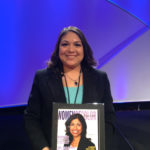
October 18, 2015–ENIGMA Post Doc Andrea Rocha one of the top 50 women featured in the “Latinas in Information Technology of Hispanic Engineer and IT” magazine. She was honored for her contribution during the Women of Color (WOC) STEM Conference in Detroit on October 16, 2015.
Andrea Rocha is a post-doctoral fellow in the Biosciences Division at Oak Ridge National Laboratory. Rocha anchors the field sampling efforts at the Oak Ridge Field site in radioactively contaminated areas as well as background sites. As part of the ENIGMA [Ecosystems and Networks Integrated with Genes and Molecular Assemblies], a multi-institutional collaborative project, Rocha is trying to determine subsurface keystone bacteria species differences in gradients of pH, nitrate, uranium, and conductivity to enable modeling of microbial community resiliency. During her academic and research career, Rocha has received numerous honors and awards. These include the Facilis 2014 workshop travel award, American Society of Microbiology (ASM) minority travel award, Delores Auzzune Fellowship, Carl Storm Underrepresented Minority Fellowship, GEM fellowship, Successful Latino Student Award, Alfred P. Sloan fellowship, Florida-Georgia Louis Stokes Alliance for Minority Participation, Bridge to Doctorate Fellowship, and Hall-Bonner Fellowship.
A person performing technological functions, who has designed, developed, managed, or assisted in the development of a product, service, system, or intellectual property that is a substantial achievement in the field. The overall impact of technological achievement is the prime consideration, regardless of title or degrees earned. The committee sees a nominee that offers broad impact and high value to society as a whole.
Women recognized at this event include Special Recognition honorees, Promotion of Education Awardees as well as the women featured in the issues of Women of Color magazine and Hispanic Engineer magazine. Some of the attendees include the Department of Defense officials, military service chiefs, political leaders, corporate executives and many others who promote workforce diversity and inclusion.
Through our participation in WOC STEM development programs, we hope to engage young people, build relationships, and influence STEM as a career choice for young people. Andrea serves as a role model for other postdocs and we are pleased to support her efforts in science.
Visiting STEM students gain insight to microbial metabolomics
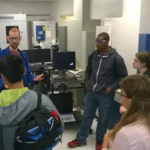
May 27, 2015–CSUEB sponsored STEM Career Awareness Day, visiting high school students view an active demonstration of the mass spectrometry-based techniques used to understand microbial community metabolomics in the Northen Lab.
In support of the Cal State University East Bay (CSUEB) sponsored STEM (Science Technology Engineering Maths) Career Awareness Day, Northen Lab hosts high school students to view an active demonstration of the mass spectrometry-based techniques that we use to understand microbial community metabolomics.
The Northern lab hosted ~60 high school students as part of the STEM Career Awareness Day sponsored by CSUEB. Groups of students were given a brief introduction to microbial metabolomics. At two stations, the students had an overview of MALDI (matrix-assisted laser desorption ionization) and NIMS (Nanostructure-Initiator Mass Spectrometry) technologies and their use in mass spectrometry imaging and high throughput analysis; or a glimpse into how LC/MS (Liquid chromatography-mass spectrometry) provides separation based analysis for a variety of applications.
These concepts were explained in the context of microbial community interactions or how microbes transform their environments and interact with one another to help us understand metabolite cycling and microbial succession in soil communities. Northern Lab staff hosting the students answered questions prompted by the visit, most of which were related to a career path, daily work responsibilities, as well as the societal relevance and applications of our research.
ENIGMA researcher Michela Catena is a Fulbright Scholar this fall!
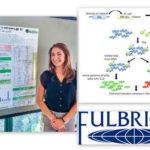
May 5, 2015–ENIGMA student Michela Catena has been selected for a Fulbright Scholarship near Kochi, Kerala, India. While in the Mukhopadhyay Lab, Michela worked with Desulfovibrio vulgaris on ENIGMA projects to better understand two-component signaling systems in bacteria. D. vulgaris has three chemotaxis systems, and she helped to characterize the CheA3 mutant using the Palleroni chamber assay and showed that the CheA3 is the primary chemotactic system used by D. vulgaris. This work was published in the journal Frontiers in Microbiology “Ray J, Keller KL, Catena M, et al. Exploring the role of CheA3 in Desulfovibrio vulgaris Hildenborough motility. Frontiers in Microbiology. 2014;5:77. doi:10.3389/fmicb.2014.00077″
This experience in Aindrila’s group introduced her to microbiology research and its wide range of topics and possibilities. She became very interested in the role that microbes play in nature, from mediating plant-soil interactions to biogeochemical cycles. She applied to the Fulbright scholarship to add a social and cultural aspect to her research experience because she hopes to enter the field of water resource management and international development. She’ll be combining her experience in microbiology with her passion for environmental remediation by conducting a microbial source tracking study to detect the source of pathogenic bacteria in waterways near Kochi, Kerala, India. She’s very excited about this new adventure and thankful for her experience working for Aindrila on ENIGMA projects.
Best of luck with this impressive project!
Trent Northen is “Science Guy”!
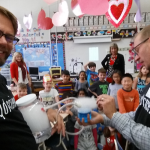
ENIGMA, February 20, 2015–ENIGMA’s Trent Northen is ‘Science Guy’ at Buena Vista Elementary in Walnut Creek CA for 3rd annual outreach to 22 classes of ~525 k-5 students. He uses a cart of science demos aimed at encouraging STEM careers and participation in the science fair (which he also helps judge). Joined here by his brother Dr. Mike North, currently on Outrageous Acts of Science (science channel).