
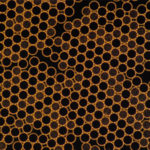
October 18, 2019–Fanchao Song of Arkin Lab was selected to compete in Berkeley Lab “Early Career Scientist and Research SLAM.” Here is his presentation from the SLAM “I am a Bubble Player,” which was selected from a competitive field of 42 entries. This is the “3-minute-describe-your-work-in-layman-terms” challenge that Berkeley Lab is hosting for postdocs. Finalists receive coaching via “Making the Most of Your Presentation” workshop, a unique opportunity to get one-on-one feedback from a globally renowned speaker, Jean-Luc Doumont of Principiae. Finalists had a chance to win a $3,000 first prize! You can read more about the results https://slam.lbl.gov/ He shares his experience, to encourage other team members to participate! How did you initially hear about the SLAM? I heard about SLAM when the lab called for the participation on SLAM2018. I read the instructions and felt it is interesting.
Outreach
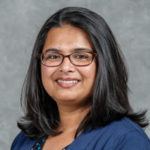
Dr Romy Chakraborty Wins Director’s Award for Outreach
https://recognition.lbl.gov/laureates/
2019 Outreach: ROMY CHAKRABORTY, Citation: In recognition of Romy Chakraborty’s extensive service as a mentor for programs that engage underrepresented groups in science, and for her significant contribution to outreach that aims to increase diversity, equity, and inclusion in STEM fields.
About the Director’s Awards
The Director’s Awards program recognizes significant achievements of Lab employees. Each year, these awards are given for accomplishments, leadership, collaboration, multi-disciplinary science, cross-divisional projects, and commitment to excellence in support of the Lab’s mission and strategic goals. Each year, Berkeley Lab employees submit nominations of individuals and teams, which are then reviewed by a Lab-wide Director’s Awards committee.
Sulfonate utilization by Desulfovibrio may expand ecological niches
September 18, 2019–Day, L.A.; K.B. De León, M.L. Kempher, J. Zhou, J.D. Wall (2019) Complete Genome Sequence of Desulfovibrio desulfuricans IC1, a Sulfonate-Respiring Anaerobe. Microbiology Resource Announcements. [doi]: 1128/MRA.00456-19
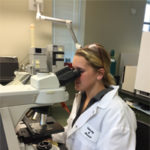
As part of ongoing work related to the 100-Well Survey of the Oak Ridge Reservation (ORR) supported by ENIGMA, Leslie Day, an undergraduate student, has published a genome announcement for a strain of Desulfovibrio, a sulfate-reducing bacterium (SRB), that grows by respiration of sulfonates. Genome comparisons have identified a candidate pathway and probes to explore the taxonomic distribution of this metabolism. Data from the earlier survey work showed that the SRB and sulfate were nearly mutually exclusive in the groundwater of the ORR prompting Leslie to determine if alternative sources of sulfate could possibly explain this result. A literature review pointed to sulfonates, ubiquitous in nature, as potential electron acceptors for SRB. As part of the Environmental Ark Campaign, she has shown that the sulfonate isethionate is used by a subset of SRB as a terminal electron acceptor and has identified the transporter and potential metabolic pathway for isethionate. The widespread distribution of sulfonates in the terrestrial environment may contribute to an understanding of the abundance of SRB in niches low in sulfate.
David Stahl Honored by Seattle Aquarium
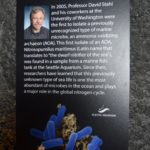
January 8, 2019–We know David Stahl as a Principal Investigator in ENIGMA working in part on the microbial conversion of ammonia to nitrate, a major step in the global nitrogen cycle.
Not only is he an internationally renowned microbial ecologist, elected to the National Academy of Engineering in 2012; now he is also a local Seattle celebrity! His discovery, that ammonia-oxidizing archaea (AOA) microorganisms are the dominant nitrifiers in most natural systems, was honored by a plaque at the Seattle Aquarium. His team was first to isolate AOA microorganisms from a water sample taken from a fish tank at the Seattle Aquarium.
https://www.ce.washington.edu/news/article/2019-01-03/david-stahls-discovery-honored-seattle-aquarium
ENIGMA’s Lauren Lui is Berkley Lab SLAM Finalist!

September 5, 2018–Lauren Lui of Arkin Lab is a Finalist Selected to Compete in Berkeley Lab “Early Career Scientist and Research “SLAM”
Date: Sept. 20, 2018
Time: 4 pm
Location: Building 50 Auditorium
NOTE: winners are chosen via in-person audience voting – so all local team should go support Lauren!
The SLAM will be streamed live so remote team members can show their support.
This is the “3-minute-describe-your-work-in-layman-terms” challenge that Berkeley Lab is hosting for postdocs.
She recorded & submitted a video “Microbial War and Peace” which was selected from a competitive field of 32 entries.
Finalists receive coaching via “Making the Most of Your Presentation” workshop, a unique opportunity to get one-on-one feedback from a globally renowned speaker, Jean-luc Doumont of Principiae.
Lauren will participate in the in-person competition next month for a chance to win $3,000 first prize!
You can read more here https://today.lbl.gov/2018/09/05/finalists-selected-to-compete-in-sept-20-postdoc-research-slam/
May “Microbial war and peace” win!
Link to the original invitation to participate: https://today.lbl.gov/2018/05/17/postdocs-and-early-career-scientists-can-win-cash-prizes-at-lab-research-slam/
ENIGMA Team Anchors Collaboration to Accelerate Experiment-based Gene Function Assignments
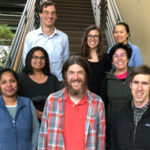
ENIGMA, May 16, 2018–As part of a large scale collaboration, a diverse team of scientists from ENIGMA — A Scientific Focus Area at Lawrence Berkeley National Laboratory (Berkeley Lab) — and other institutions lead by Adam Arkin (APA) as Technical Co-Manager, as well as researchers at the U.S. Department of Energy (DOE) Joint Genome Institute (JGI), have developed a workflow that enables large-scale, genome-wide assays of gene importance across many conditions. Released in the journal Nature, “Mutant Phenotypes for Thousands of Bacterial Genes of Unknown Function,” describes the identification of mutant phenotypes for thousands of bacterial genes that have no currently known function. Read more at LBL News Center.
From back row left: Adam Deutschbauer, Jen Kuehl, Hualan Liu, Romy Chakraborty, Astrid Terry, Jayashree Ray, Morgan Price, and Hans Carlson. Missing from the picture: Adam Arkin, Kelly Wetmore, Judy Wall, Grant Zane, et al
The ENIGMA team was brought together from multiple institutions/labs through the vision of Adam Arkin to work together on mission-critical science under the leadership of Adam Deutschbauer and Morgan Price (Arkin Lab) including the support of Kelly Wetmore (Arkin Lab Graduate Student), Jennifer Kuehl (Arkin Lab), Hualan Liu (Deutschbauer Lab), Romy Chakraborty, Jayashree Ray(Deutschbauer Lab), Hans Carlson (Deutschbauer Lab), Judy Wall, Grant Zane (Wall Lab), JGI’s Matthew Blow and other collaborators.
Deutschbauer lab is expert in microbiology, genetic technology development, high throughput culturing and quantitative assessment of microbial growth under diverse conditions; the Blow lab (co-corresponding) and JGI are expert in the application of advanced sequencing technologies to the assessment of biological function; the Arkin lab is expert in microbial biotechnology, systems and synthetic biology, and biological data science. The Chakraborty lab is an expert in environmental microbiology and isolation and characterization of microbes. The Wall lab is an expert in microbial genetics, biochemistry, and physiology.
With the analysis/interpretation support tools http://fit.genomics.lbl.gov/ developed by Morgan Price integrated into ENIGMA’s resource pipeline, the next steps will be to transfer these technologies to fungi with collaborating UC Berkeley scientist Jeff Skerker (Arkin Lab), apply new genetic technologies such as DUB-SEQ developed by ENIGMA research scientist Vivek Mutalik (R&D 100 winner! Arkin Lab), and the Arkin Lab’s growing expertise with CRISPR techniques, to significantly accelerate the functional analysis of microbes. — There are opportunities here both to innovate in the technology and apply it to well-chosen diversity in more informative and DOE relevant environments.
ENIGMA team bolded: Morgan N. Price1, Kelly M. Wetmore1, R. Jordan Waters2, Mark Callaghan1, Jayashree Ray1, Hualan Liu1, Jennifer V. Kuehl1, Ryan A. Melnyk1, Jacob S. Lamson1, Yumi Suh1, Hans K. Carlson1, Zuelma Esquivel1, Harini Sadeeshkumar1, Romy Chakraborty3, Grant M. Zane4, Benjamin E. Rubin5, Judy D. Wall4, Axel Visel2,6, James Bristow2, Matthew J. Blow2,*, Adam P. Arkin1,7,*, Adam M. Deutschbauer1,8,*
1Environmental Genomics and Systems Biology Division, Lawrence Berkeley National Laboratory
2Joint Genome Institute, Lawrence Berkeley National Laboratory
3Climate and Ecosystem Sciences Division, Lawrence Berkeley National Laboratory
4Department of Biochemistry, University of Missouri
5Division of Biological Sciences, University of California, San Diego
6School of Natural Sciences, University of California, Merced
7Department of Bioengineering, University of California, Berkeley
8Department of Plant and Microbial Biology, University of California, Berkeley
MJB (MJBlow@lbl.gov)
APA (APArkin@lbl.gov)
AMD (AMDeutschbauer@lbl.gov)
Funding for the development of the microbiology and initial technology was supported by the ENIGMA “Discovery Program”; where high risk projects are funded for a short duration to encourage high impact changes in science or technological capability that extend and enhance our ongoing research; and the sequence for the study was enabled by the JGI Community Sequencing project for the broad application to microbes of DOE Community interest.
Leslie Day ENIGMA undergrad Honorable mention for poster Mizzou Life Sciences Week 2018
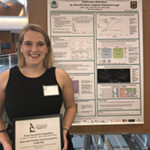
April 22, 2018–Leslie, a Senior in Biochemistry working in the laboratory of Judy Wall, received an honorable mention for her poster presentation titled “Sulfonate Utilization by Desulfovibrio vulgaris Hildenborough” at Mizzou Life Sciences Week 2018 in a competition among all presenting post-doctoral fellows, graduate students, and undergraduates in Ecological, Evolutionary, and Developmental Biology. In the 100 Well Survey of the Oak Ridge Reservation done by ENIGMA, sulfate-reducing bacteria and sulfate are nearly mutually exclusive in the groundwater. To predict the presence and metabolism of sulfate-reducing bacteria as part of the Environmental Ark Campaign, we must understand what oxidized sulfur compounds are available and can be utilized by sulfate-reducing bacteria. Leslie is characterizing sulfonates, ubiquitous in nature, as potential electron acceptors for sulfate-reducing bacteria. She has shown that many sulfate reducers can utilize the sulfonate isethionate as a terminal electron acceptor and has identified the transporter and potential pathway for isethionate utilization. She is currently writing the manuscript for the work described in this poster for publication in a peer-reviewed journal. Leslie has been working in the Wall lab as part of ENIGMA since Fall 2014 and upon graduation plans to enter a Ph.D. program to pursue her interest in environmentally-relevant anaerobes. Poster Title: Sulfonate Utilization by Desulfovibrio vulgaris Hildenborough
Authors: Leslie A. Day, Kara B. De Leon, Judy D. Wall
Erica Majumder wins best overall poster at the International Symposium on Microbial Sulfur Metabolismw

April 18, 2018–ENIGMA postdoc Erica Majumder’s poster “Beyond Sulfide: The Sulfur-Metabolome of Sulfate-Reducing Bacteria” affirms ENIGMA’s contribution to the ability to sulfur sulfur metabolism on a molecular level. Sulfur-containing metabolites are key to the maintenance of the redox state of the environment, the cycling of essential nutrients between microbes, the interaction of some microbes with metals, and can inhibit other metabolisms such as nitrate reduction. This project developed tools to be able to assay sulfur-containing metabolites and to begin to tease out their functions in microbial community interactions.
Authors: Erica L.-W. Majumder, Tao Huan, Erica M. Forsberg, Chavi Domingo, Gary Siuzdak, Judy D. Wall
Affiliations: 1-Mizzou, 2- Scripps
A strategy to determine all sulfur-containing metabolites from global untargeted metabolomics experiments has been employed to study the total metabolome and the sulfur-ome of model Sulfate-Reducing Bacterium (SRB) Desulfovibrio vulgaris Hildenborough (DvH). Total metabolite populations were measured from DvH samples at different growth stages, on different amounts of sulfate, with competing sulfur sources, spent media, and on medium simulating the groundwater at Oak Ridge Field Research Center. The metabolome and sulfur-ome of a nitrate-reducing bacterium, a different sulfate-reducing bacterium, and E. coli were also measured using the same treatment. Using a new script we developed, the sulfur-containing metabolites were identified from the data sets. SRB was found to produce more and distinct sulfur-containing metabolites than non-sulfur respiring bacteria. For DvH, the growth stage, sulfur source, and sulfate concentration impacted the sulfur-ome. The biosynthesis or assimilation of these sulfur-containing metabolites was further queried with stable isotope experiments by replacing sulfate with 34 SO4 2-. DvH was found to assimilate sulfur from sulfate into certain sulfur-containing metabolites. Overall, this work indicates that the population of sulfur-containing metabolites is larger than expected, assimilative pathways are happening in dissimilatory SRB, and in addition to hydrogen sulfide, excreted sulfur-containing metabolites could be playing a role in the various environments of SRB. We have developed a new way to study sulfur metabolites in systems, which is desirable because of their reactivity and chemical properties for field and medical applications.
Her award was tweeted https://twitter.com/SulfurMicrobes/status/986720725481517056