
Microbial methanogenesis is responsible for ~70% of global methane emissions, and methane contributes to ~20-30% of total global warming potential. While complex factors influence methane fluxes, the nature of the organic carbon that feeds methanogenic microbiomes plays a central role. In recent work published in Nature Communications, Hu et al. use a combination of microbial physiology and metagenomics in laboratory microcosms to investigate how variations in the nominal oxidation state of organic carbon (NOSC) influence carbon degradation rates, gaseous product yields, and microbiome composition.
In rice paddy sediment microcosms, the authors find that, consistent with thermodynamic and stoichiometric modeling, negative NOSC compounds are catabolized more slowly but produce more methane per mole of carbon. This rate/yield tradeoff is important for predicting methane fluxes in natural environments, but it is not well described in the scientific literature.
The authors also found that NOSC can influence microbiome composition. Negative NOSC microbiomes have higher alpha diversity, more syntrophs and methanogens, and fewer fermentative bacteria. Notably, different taxa of fermentative bacteria display genomically encoded NOSC catabolic preferences both in the lab and in the field. Negative NOSC-preferring fermenters have longer predicted doubling times, consistent with the thermodynamic recalcitrance of their preferred substrates. Other microbial carbon catabolic preferences are described (e.g. sugar:acid preference, C:N preference, carbon class preference), but NOSC preference may reflect the thermodynamic niche of microorganisms. The authors propose that extending research on microbial catabolic preferences is likely to improve our understanding of microbial carbon cycling and trait evolution.
Impact to Field/Science
By linking thermodynamic calculations with high-throughput microcosm experiments, genome-resolved metagenomics, and continental-scale rice field data, this work elucidated the linkages between organic matter chemistry and microbiome assembly, and discovered a carbon catabolic preference that controls global methane fluxes.
Significance to ENIGMA
The discovery that bacteria display preferences for the nominal oxidation state of carbon that they use for energy that are observable in the field and lab and related to other microbial traits such as growth rate is important because it helps us better understand how changes in organic matter influence the structure and function of microbiomes.
Collaborations
UC Berkeley, Energy and Biosciences Institute, Shell, Southern Methodist University
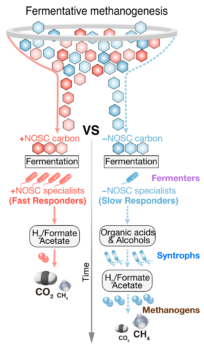
In fermentative methanogenic microbiomes, reduced organic carbon with a negative nominal oxidation state (NOSC) is catabolized by slow-growing specialist fermentative bacteria. Degradation of negative NOSC carbon also enriches for syntrophic bacteria and methanogenic archaea and yields more methane per mole carbon.
Image Credit: https://doi.org/10.1038/s41467-026-73281-z
Funding Acknowledgement
This study was financially supported by the Energy & Biosciences Institute (EBI) through the EBI-Shell program and some co-authors are members of ENIGMA (Ecosystems and Networks Integrated with Genes and Molecular Assemblies; http://enigma.lbl.gov), a Science Focus Area Program at Lawrence Berkeley National Laboratory, funded by the US Department of Energy, Office of Science, Biological and Environmental Research Program under contract number DE-AC02-05CH11231 to Lawrence Berkeley National Laboratory.
Publication:
Hu, R., Aronson, H.S., Weaver, M.E. et al. Organic carbon oxidation state shapes fermentative methanogenic microbiomes and controls greenhouse gas fluxes. Nat Commun 17, 6621 (2026). https://doi.org/10.1038/s41467-026-73281-z
Contact:
Hans Carlson