
The development of a high-throughput method by for determining the function of predicted proteins of unknown function marks a significant advancement in the field of microbial biology. By utilizing DNA barcode sequencing and auxotrophic strains of E. coli, ENIGMA Researchers at Lawrence Berkeley National Laboratory can now assign functions to many previously uncharacterized genes. This breakthrough enables more complete identification of microbial genome contents, leading to better formation of genome-scale metabolic models.
This work has substantial implications for the ENIGMA project, as it paves the way for the creation of more comprehensive metabolic models. These models are crucial for ENIGMA’s long-term ecological modeling goals. The demonstrated workflow provides a template for extending this research, allowing for further exploration of microbial genomes and their functions.
 Biggs BW, Price MN, Lai D, Escobedo J, Fortanel Y, Huang YY, Kim K, Trotter VV, Kuehl JV, Lui LM, Chakraborty R, Deutschbauer AM, Arkin AP. High-throughput protein characterization by complementation using DNA barcoded fragment libraries. Mol Syst Biol 2024;20:1207–29. https://doi.org/10.1038/s44320-024-00068-z.
This publication is a collaborative effort between the Arkin Lab and the Deutschbauer Lab. The work builds upon previous research, including a synergistic paper by Huang et al. (2024), which introduced Boba-seq, a platform for single DNA barcoding of overexpression libraries. Yolanda Yue Huang (now at State University of New York (SUNY) Buffalo) developed the tool that can be broadly applied to study any bacteria of interest. The techniques developed in this study, including library construction and long-read sequencing, enabled Bradley Biggs (now at University of Michigan) to construct overexpression libraries (Coaux-seq) leading to to the discovery of new metabolic enzyme functions among ENIGMA isolates using high-throughput complementation screens. These techniques will continue to be useful for ENGIMA related missions in dissecting the molecular pathways encoded among environmental bacteria.
Huang, Y.Y.; M.N. Price, A. Hung, O. Gal-Oz, S. Tripathi, C.W. Smith, D. Ho, H. Carion, A.M. Deutschbauer and A.P. Arkin (2024) Barcoded overexpression screens in gut Bacteroidales identify genes with roles in carbon utilization and stress resistance. Nature Communications. [DOI]:10.1038/s41467-024-50124-3 {PMID}:39103350 PMCID:PMC11300592 OSTI:2426698
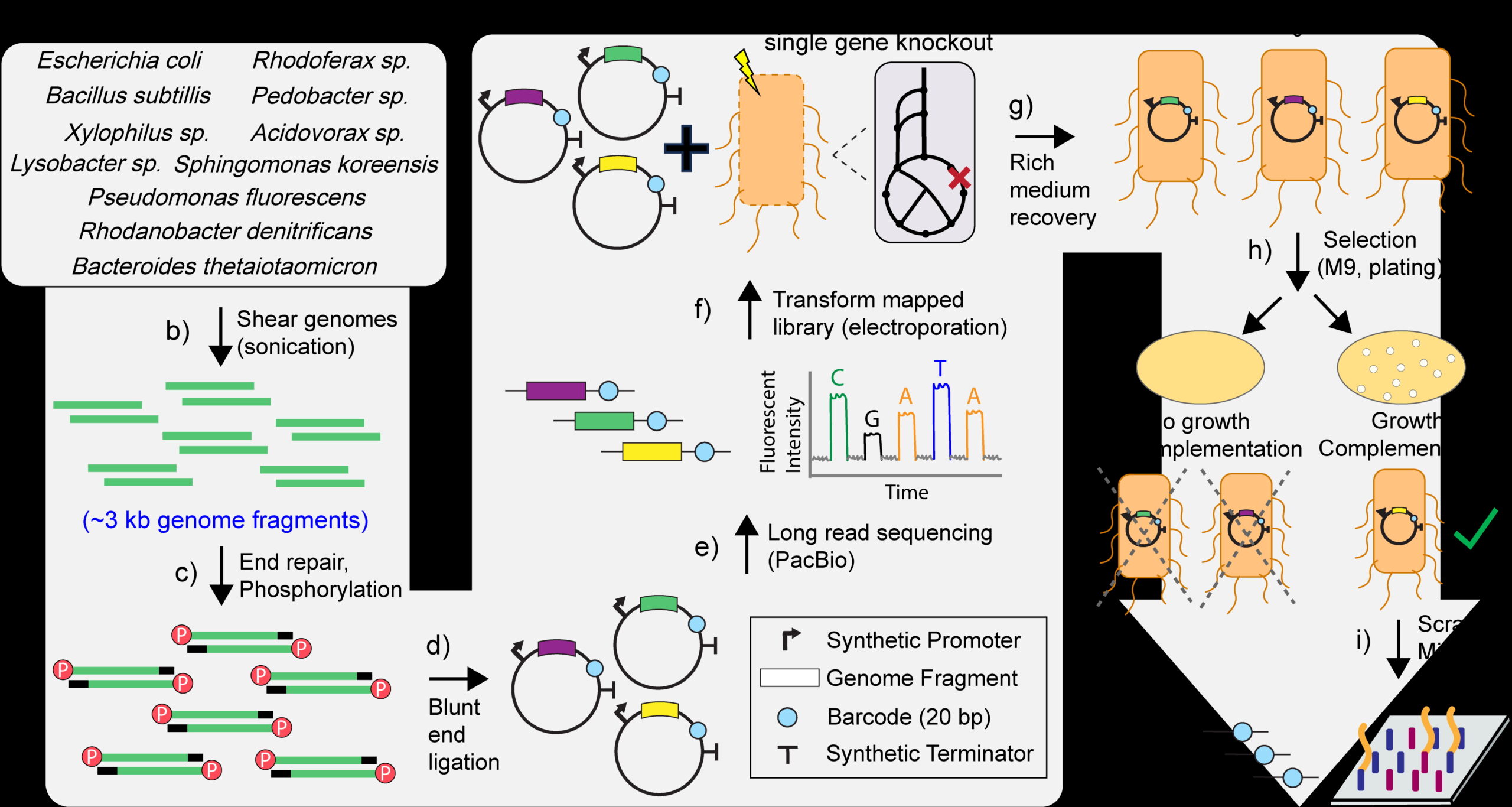
Image Credit: Bradley Biggs – Illustrator.