
Researchers have isolated Nitrobacter vulgaris strain MLSD-S22 from subsurface groundwater at the Oak Ridge Reservation, where contamination has created challenging conditions for nitrogen-cycling microbes. The new strain shows strong growth and nitrite oxidation across a wide range of environmental conditions, with high affinities for nitrite and oxygen that suggest it can thrive and compete in low-substrate settings. While MLSD-S22 is a robust nitrite oxidizer, its greater sensitivity to nitrate indicates that nitrate levels in some field regions may suppress nitrite-based growth. Notably, its genome (a 4.18 Mb chromosome plus two plasmids) contains an unexpected nitrous oxide reductase (nos) operon, expanding known Nitrobacter diversity and pointing to potential, previously unrecognized roles in nitrogen loss.
Impact to Field/Science
The isolate’s genome encoded a clade I nitrous oxide reduction operon but activity was not observed under the conditions tested. This implies a yet unidentified role for nitrous oxide reduction by a metabolic group of organisms demonstrated to be metabolically flexible. The strain’s high affinity for nitrite and O₂, coupled with sustained growth and continued activity at high nitrate concentrations even when growth is inhibited, indicates that it is a metabolically robust nitrite oxidizer under diverse conditions.
Significance to ENIGMA
This high O2 and nitrite affinity of this isolate indicates a potential role in the low O2 and nitrite subsurface potentially competing at the edge of the thermodynamic ladder between O2 respiration and denitrification, scavenging both nitrite and O2, but being excluded from the high nitrate contamination of area 3.
Collaborations
University of Washington Seattle: Zachary Flinkstrom, Kristopher A. Hunt, Britt Abrahamson, David A. Stahl, Mari-Karoliina H. Winkler
Institute for Systems Biology: James Wilson, Zachary S. Cooper, Jacob J. Valenzuela, Nitin S. Baliga
University of Oklahoma: Pierce Harvell, Xiangpeng Li, Wei Qin (now at the University of Illinois Urbana-Champaign)
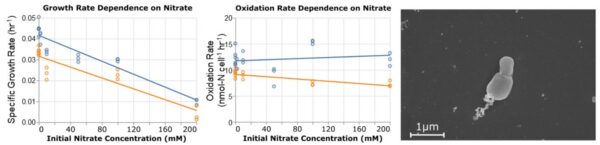
Nitrate inhibition of growth but not activity indicate a metabolically robust nitrite oxidizer Nitrobacter vulgaris MLSD-S22, shown here.
Image Credit
Zachary Flinkstrom
Funding Acknowledgement
This work was supported by the U.S. Department of Energy under award number DE-SC0020356, by the U.S. Department of Energy Early Career Research Program (DE-SC0025455 to W.Q.), and by startup funds of the University of Illinois Urbana-Champaign and University of Oklahoma to W.Q. P.H. was also supported by the Provost’s Summer Undergraduate Research and Creative Activity Fellowship at the University of Oklahoma. This work was also supported by ENIGMA-Ecosystems and Networks Integrated with Genes and Molecular Assemblies (http://enigma.lbl.gov), a Science Focus Area Program at Lawrence Berkeley National Laboratory based upon work supported by the U.S. Department of Energy, Office of Science, Office of Biological and Environmental Research under contract number DE-AC02-05CH11231.
Publication
Flinkstrom Z, Hunt KA, Abrahamson B, Harvell P, Li X, Wilson J, Cooper ZS, Valenzuela JJ, Baliga NS, Stahl DA, Qin W, Winkler MH. Comparative physiological and genomic characterization of a novel Nitrobacter vulgaris strain from a nitrate-contaminated subsurface. Appl Environ Microbiol0:e00130-26. [doi]:10.1128/aem.00130-26 OSTI: 3025057
Contact
Kristopher Hunt
hunt0362@uw.edu