
This review systematically synthesizes current knowledge on groundwater microbiomes in terms of diversity, interactions, biogeography, function and community assembly. Groundwater microbiomes harbor the extraordinary diversity of prokaryotic, microeukaryotic and viral communities, with complex interactions between these different microbial groups. These groundwater microorganisms exhibit distinct biogeographic patterns, with key differences and similarities across groundwater types and other habitats. The structure and dynamics of groundwater microbiomes are shaped by both biotic and abiotic factors, and stochastic processes are more important than deterministic processes in community assembly. With regard to their function, groundwater microbiomes have crucial roles in shaping ecosystem functioning, including biogeochemical cycling, water quality and One Health. Their dual role in influencing water quality and health indicate their potential use in groundwater bioremediation and protection. Finally, we highlight several future prospects for research to harness microbiomes as eco-sustainable solutions for groundwater restoration and protection in a changing world.
Impact to Field/Science
This review presents a comprehensive map of the life beneath our feet. It highlights the natural and human-driven forces and underlying microbial mechanisms that should be considered when predicting how groundwater ecosystems respond to pollution, pumping, water recharge, and climate change. These insights could improve microbial-based monitoring of contamination, harmful pathogens, and antibiotic resistance, and also guide the use of native microorganisms to remove different contaminants such as nitrate, heavy metals, and organic pollutants. Together, this review points out the considerable potential of microbial-based solutions for achieving sustainable groundwater health in the future.
Significance to ENIGMA
One of the most valuable insights is that groundwater ecosystem functioning depends strongly on microbial composition, interactions, functions, and assembly mechanisms, as well as on their driving forces from both anthropogenic and geogenic contamination. Given the extraordinary diversity of groundwater microbiomes, the largely uncharacterized microorganisms and their genes could also reveal novel mechanisms for contaminant transformation. These views support the main goal of ENIGMA, which is to provide an unprecedented mechanistic and predictive understanding of complex environmental bioprocesses in the shallow subsurface of a contaminated watershed. It also provides a broad framework for linking field measurements, laboratory studies, microbiome data, and biogeochemical models that can guide groundwater restoration and protection. In addition, extending this framework to sediment-attached communities is critical because these underexplored communities might be ecologically distinct from planktonic communities in terms of microbial-mediated biogeochemical processes.
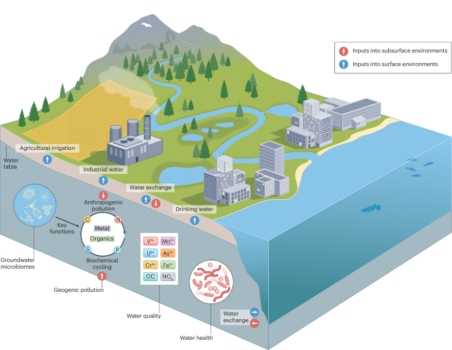
Image Credit: Image courtesy of Zongzhi Wu et al., University of Oklahoma
Funding Acknowledgement
This Review is supported by ENIGMA (Ecosystems and Networks Integrated with Genes and Molecular Assemblies; http://enigma.lbl.gov), a Science Focus Area Program at Lawrence Berkeley National Laboratory, the US Department of Energy, Office of Science, Office of Biological and Environmental Research under contract number DE-AC02-05CH11231 (to P.D.A., A.P.A., J.Z., T.C.H. and M.W.F.). The Review was partially supported by NSF grants EF-2025558 and DEB-2129235 (to J.Z. and D.N) and the Office of the Vice President for Research at the University of Oklahoma (to J.Z.).
Publication
Wu, Z., Ning, D., Fields, M.W. et al. Diversity, biogeography and assembly mechanisms of groundwater microbiomes. Nat Rev Earth Environ (2026); [doi]:10.1038/s43017-026-00813-y. OSTI: 3484765
Contact
Zongzhi Wu
Zongzhi.Wu-1@ou.edu